PBS/PBC: Splitting Light by Polarization, Not Wavelength
A wavelength filter splits light by color. A tap splits it by power ratio. A polarization beam splitter (PBS) splits it by polarization state — sending one linear polarization out one port and the orthogonal polarization out the other. Run the same device backward and it's a polarization beam combiner (PBC), merging two polarization states onto a single fiber. Same part, same two output ports, direction decides the name.
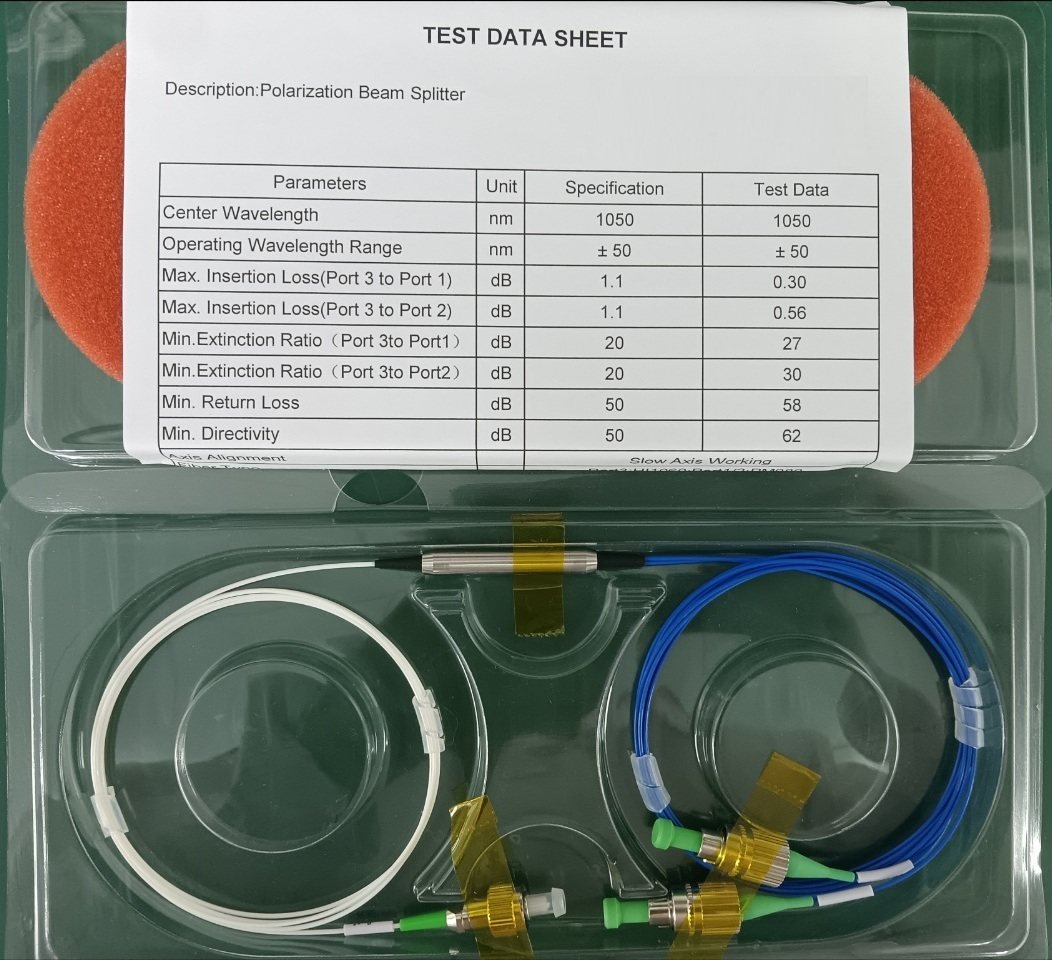
This is a real unit tested at a 1050 nm center wavelength, ±50 nm range. Run as a splitter, light enters Port 3 and splits between Port 1 and Port 2 by polarization state; run in reverse as a combiner, Port 1 and Port 2 each feed one polarization state in and Port 3 carries both out. The table below is the actual test data for this unit.
| Parameter | Spec | Measured |
|---|---|---|
| Center wavelength | 1050 nm ±50 nm | — |
| Insertion loss, Port3→Port1 | ≤ 1.1 dB | 0.30 dB |
| Insertion loss, Port3→Port2 | ≤ 1.1 dB | 0.56 dB |
| Extinction ratio, Port3→Port1 | ≥ 20 dB | 27 dB |
| Extinction ratio, Port3→Port2 | ≥ 20 dB | 30 dB |
| Return loss | ≥ 50 dB | 58 dB |
| Directivity | ≥ 50 dB | 62 dB |
| Axis alignment | Slow axis working | |
| Fiber | PM fiber, white and blue jacket pigtails | |
Extinction ratio is the number that matters most
Insertion loss says how much total power survives the split. Extinction ratio says how clean the split actually is — how much of the unwanted polarization state leaks into the port meant to carry only the wanted one. At 27–30 dB measured against a 20 dB minimum, this unit is keeping the unwanted state roughly 500–1000× weaker than the wanted one at each output, which is what makes a PBS usable for polarization-sensitive measurement and polarization-diversity front ends rather than just a rough power split.
Return loss and directivity round out the picture: return loss covers how much light reflects straight back out the port it entered, and directivity covers how well the two output ports stay isolated from each other along the reverse path. Both sit well above their 50 dB floors here (58 and 62 dB measured), which matters in any setup feeding back into a laser or interferometric path where stray reflections aren't just lost power — they're noise.
Not a wavelength filter, and not a tap
It's worth being precise about what a PBS/PBC is not. A three-port WDM device also has one common port and two others, but it splits by wavelength — one color goes one way, the rest continue the other. An optical tap splits by a fixed power ratio, regardless of wavelength or polarization, sending a small fraction of every wavelength and every polarization state to a monitor port. A PBS/PBC ignores wavelength and power ratio entirely and splits purely on polarization state: whatever the color, whatever the intended split ratio, light in one linear polarization goes to Port 1 and the orthogonal polarization goes to Port 2. Three different three-port devices, three different physical properties being used to decide where the light goes.
On the existing PBS/PBC product line, this same 1×2 splitting/combining function is offered across four wavelength groups spanning 980–1620 nm, with insertion loss from 0.4 dB and extinction ratio to 22 dB typical for the PBS direction — the 1050 nm unit tested on this page sits inside that range and, on this particular sample, tests meaningfully better than the typical extinction ratio floor.
Specifying a PBS/PBC
- Center wavelength and band — picks which of the standard wavelength groups the device is built around.
- Direction of use — as a splitter (Port 3 in, Ports 1/2 out) or a combiner (Ports 1/2 in, Port 3 out); the hardware is the same, the datasheet orientation isn't.
- Extinction ratio target — the figure to hold a supplier to if the downstream system is sensitive to polarization crosstalk, not just insertion loss.
- Fiber and connector — PM fiber type, pigtail length and connector, matched to the rest of the polarization-maintaining path it feeds.
A polarization beam splitter/combiner and an in-line polarizer are easy to conflate since both work with polarization state — the difference is that a polarizer has one input and one output and simply blocks one axis, while a PBS/PBC has two ports on the polarization-split side and routes both axes, keeping the power that a polarizer would otherwise throw away.