PM Polarizer: One Port, One Axis, by the Test Data
An in-line polarizer doesn't split light and doesn't combine it — it takes one fiber in, one fiber out, and simply blocks the axis it doesn't want. What comes out the far end is light in a single, clean polarization state, at the cost of whatever power was riding on the axis that got blocked.
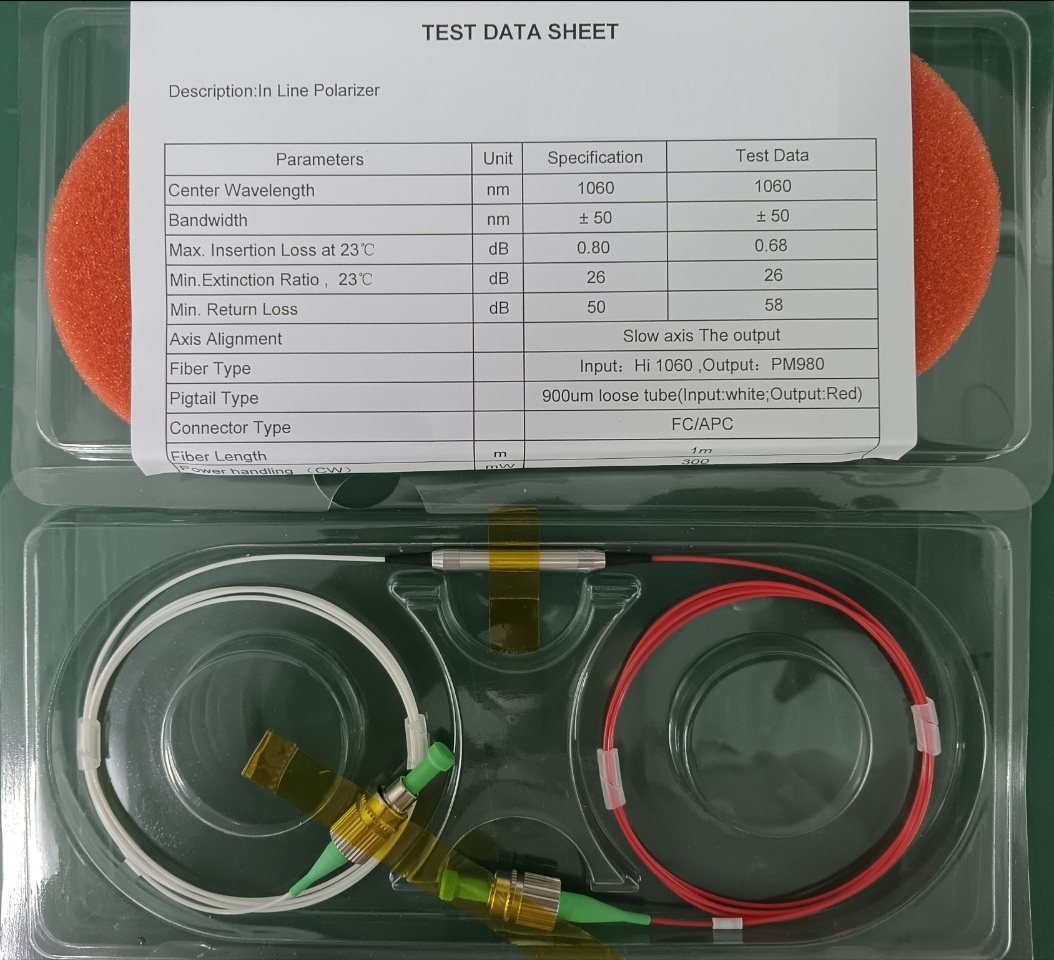
This unit is built around a 1060 nm center wavelength with a ±50 nm bandwidth. It passes the slow axis and blocks the fast axis — light launched with its polarization aligned to the slow axis passes through with low loss, while light on the orthogonal (fast) axis is attenuated well below it. The table below is the actual test data for this unit.
| Parameter | Spec | Measured |
|---|---|---|
| Center wavelength | 1060 nm ±50 nm | — |
| Insertion loss @ 23°C | ≤ 0.80 dB | 0.68 dB |
| Extinction ratio @ 23°C | ≥ 26 dB | 26 dB |
| Return loss | ≥ 50 dB | 58 dB |
| Axis alignment | Slow axis is the output | |
| Input fiber | Hi1060 | |
| Output fiber | PM980 | |
| Pigtail | 900 µm loose tube, 1 m (input white, output red) | |
| Connector | FC/APC | |
One detail worth noting on its own: the input and output fiber types are different — Hi1060 in, PM980 out. The polarizer's job is done inside the device; what leaves it needs to be carried onward on a fiber type that matches whatever it's feeding into, and here that's PM980 rather than a like-for-like Hi1060 output.
Extinction ratio at 26 dB, right at the measured value
The most notable line in this data set is that the measured extinction ratio (26 dB) sits exactly at the minimum spec floor (26 dB) rather than comfortably above it, unlike the insertion loss (0.68 measured against a 0.80 ceiling) and return loss (58 measured against a 50 floor), which both have real margin. That's worth knowing before treating this unit's extinction ratio as representative of the product line's typical performance — the published line for this polarizer platform quotes extinction ratio to 30 dB typical across its full 780–1950 nm wavelength coverage, so a unit tested exactly at 26 dB is a real sample at the lower end of that range rather than the ceiling.
Single port, single axis — and what that isn't
It's easy to see “polarization” on the label and reach for the wrong device. An in-line polarizer has exactly one input and one output; it blocks the fast axis and passes the slow axis, giving a single-port device that cleans up polarization state rather than splitting or combining it — whatever power was on the blocked axis is simply lost, not routed anywhere useful. A PBS/PBC, by contrast, has two ports on its polarization-split side and routes both axes to their own output rather than discarding one, which is the right choice whenever the power on both polarization states needs to be kept and used, not just cleaned away.
Put another way: reach for an in-line polarizer when the goal is a single clean output and the unwanted axis genuinely is unwanted; reach for a PBS/PBC when both polarization states carry information or power worth keeping and routing separately.
Specifying an in-line polarizer
- Center wavelength and bandwidth — this platform spans eight wavelength bands from 780 to 1950 nm; specify the band that covers your operating wavelength.
- Extinction ratio target — ask for the tested value, not just the spec floor, if the application is sensitive to residual fast-axis leakage.
- Input/output fiber type — confirm both ends independently; as this unit shows, they aren't always the same fiber type.
- Pigtail and connector — length, jacket color coding and connector type set per leg as with the rest of the PM line.