CWDM Packaging: Standard, Compact and Ultra-Compact by the Numbers
Every one of these parts filters the same 20 nm CWDM grid. What changes between them is the housing — from an 80×58×8 mm module built for a rack panel down to a bench small enough to disappear inside a transceiver. Smaller isn’t automatically better; each size trades footprint against loss and against what fits your assembly.
The insertion loss figure we publish for CWDM — 0.6 to 1.2 dB at 2 channels — is usually read as a manufacturing tolerance band. It isn’t. It is two different packages: 0.6 dB is the compact housing, 1.2 dB is the standard housing, on the identical wavelength plan. Package choice is the variable, not build variance.
Standard vs. compact, at the same channel count
| Package | Dimensions | Insertion loss, 2 channels |
|---|---|---|
| Standard | 80 × 58 × 8 mm | 1.2 dB |
| Compact | 45 × 25 × 6 mm | 0.6 dB |
Halving the footprint here comes with half the insertion loss, not more — the compact housing isn’t a compromise on this pair, it is a better result on both axes at 2 channels. The tradeoff shows up as channel count climbs: more filter stages packed into a smaller internal path is what eventually pushes loss up toward the 2.5–4.2 dB figure we quote at 18 channels, regardless of which housing family you started from.
What “standard” looks like in the field
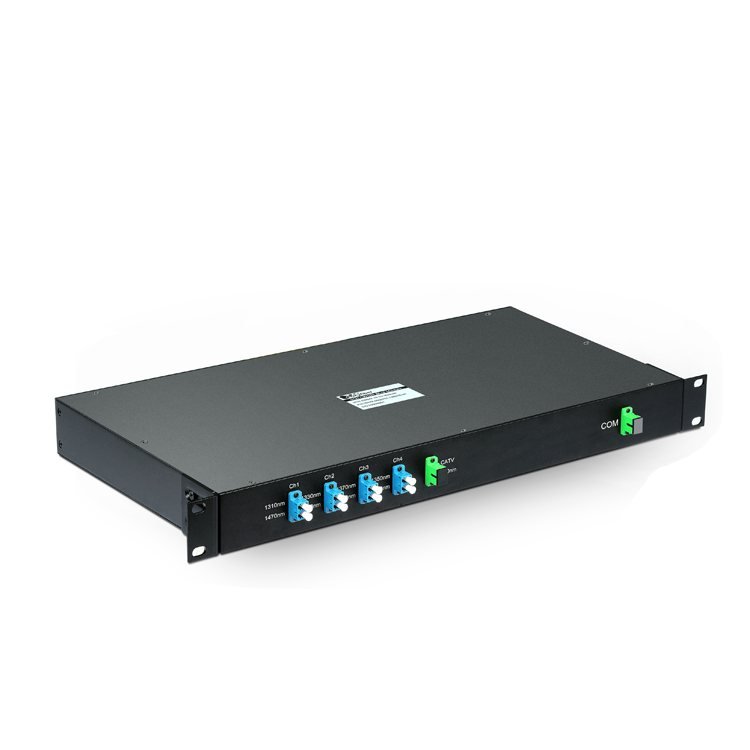
The photo at the top of this page is what a standard-class CWDM package looks like once it’s built into a product: a 1U rack module carrying four CWDM channels plus a separate CATV overlay port, meant to occupy its own slot in a chassis rather than sit inside another board or module. This is the end of the packaging spectrum where board space isn’t the constraint — connector accessibility and panel mounting are.
Compact scales with channel count too
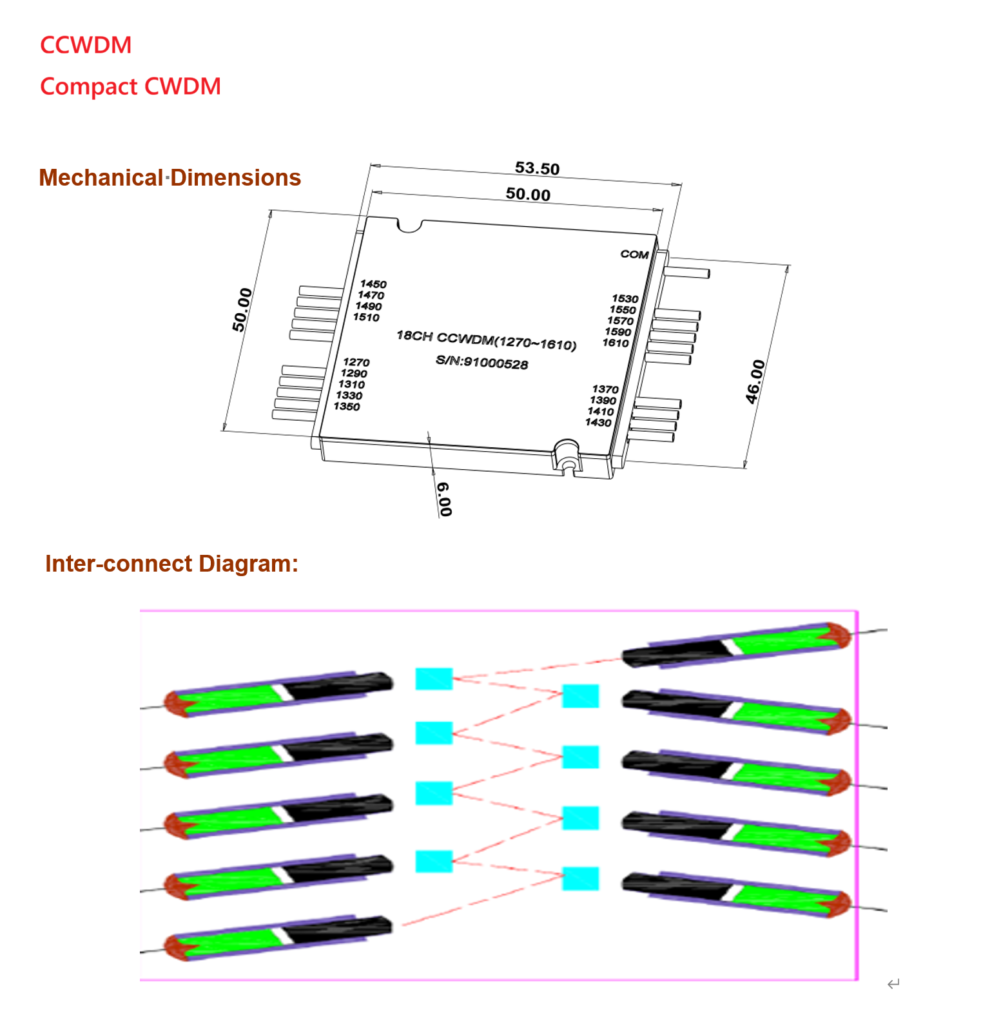
The compact housing family isn’t fixed at 45×25×6 mm — that’s the 2-channel starting point. This 18-channel CCWDM build holds the same 6 mm thickness but grows to a 53.5×50 mm footprint to fit nine times the filter stages of the baseline part, cascaded internally as shown in the interconnect diagram. Thin stays thin; footprint is what grows with channel count.
Past compact: ultra-compact
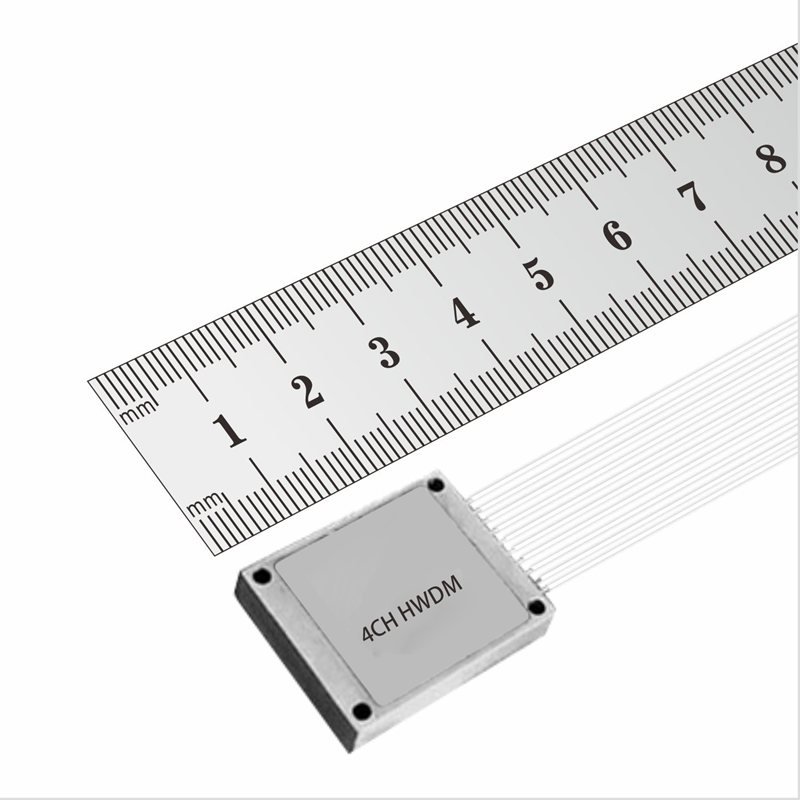
One step smaller than anything on this page is the ultra-compact end of the range — UCWDM, starting from a 20×8×6.5 mm bench. It gets there with a different optical layout, not just smaller versions of the same parts; we cover exactly how in Why UCWDM Is So Small.
Specifying a package
- Channel count — the single biggest driver of footprint within any housing family, standard or compact.
- Available board space — a rack panel slot calls for standard; a tight internal layout calls for compact or smaller.
- Loss budget — compact wins at low channel counts; at high channel counts the housing matters less than the channel count itself.
Whichever housing you land on, it holds the same choice between wiring the cascade as an OADM or as a straight MUX/DEMUX — packaging and wiring are independent decisions on the same order.
None of this changes the underlying filter — the same 20 nm grid runs through every package on this page. The housing is a packaging decision, made after the wavelength plan is set, not instead of it.