Why UCWDM Is So Small: Inside the Reflective Cascade Design
UCWDM starts from a 20×8×6.5 mm package — small enough to sit inside a transceiver housing rather than beside it. That size is not the result of shrinking ordinary WDM parts. It comes from a different optical layout: every filter stage shares one folded free-space path instead of being built, packaged and spliced as its own separate component.
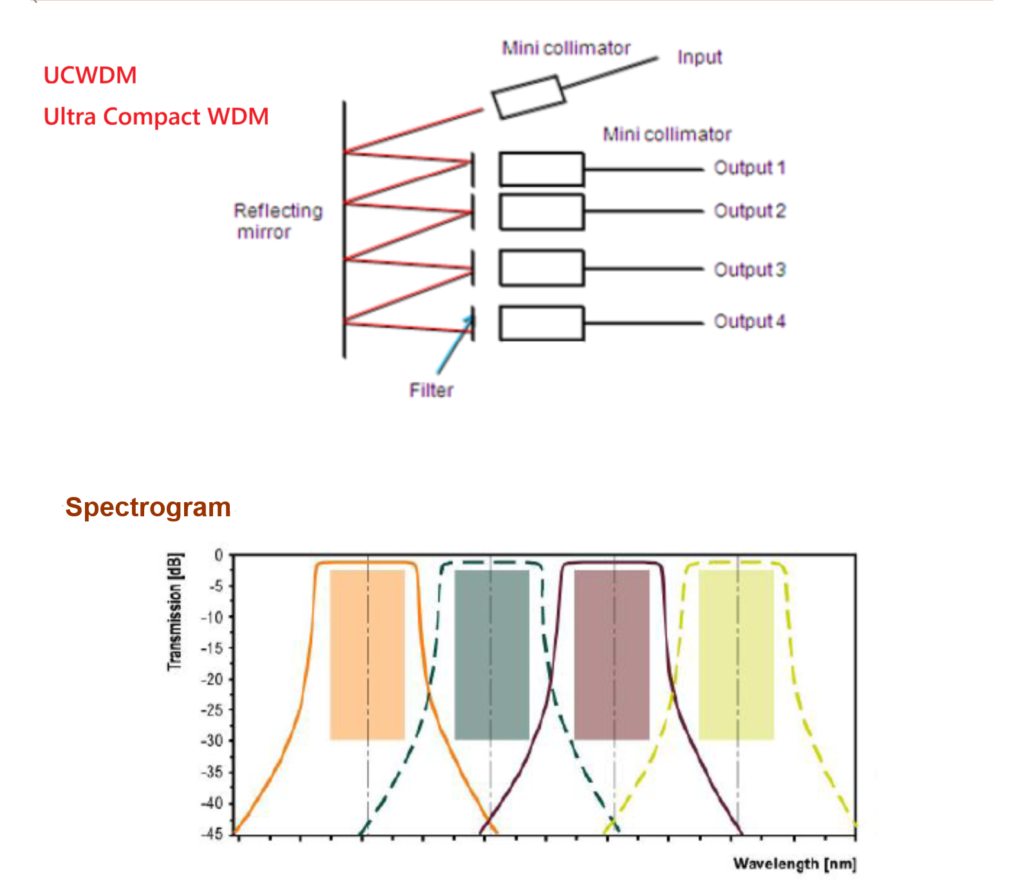
Every other WDM filter on this site — CWDM, DWDM and FWDM — is built from discrete three-port stages: a COM in, a Pass out, a Reflect out, packaged as its own small component and spliced or cascaded to the next one when a design needs more than one channel. UCWDM keeps the same COM/Pass/Reflect logic at each stage but stops packaging the stages separately.
Reading the diagram
Light enters through a single mini collimator and is aimed at a reflecting mirror. The first filter, mounted at an angle along that mirror, does the same job a discrete FWDM element does: it reflects the wavelength assigned to Output 1 into its own mini collimator, and passes everything else straight through to keep travelling along the folded path. The beam hits the next filter, Output 2's wavelength reflects off, the rest continues on — and the pattern repeats for Output 3 and Output 4 in the four-channel example shown here.
The spectrogram underneath the diagram is what that cascade produces: four passbands sitting side by side along the wavelength axis, each one cut off cleanly against its neighbors so a given wavelength only ever lands in one output.
Why folding the path saves the space
Build four separate FWDM-style filters, splice them together in series, and each one carries its own housing, its own epoxy joints, its own fiber-to-filter alignment overhead, and its own length of pigtail between stages. Fold the same four filter stages onto one shared mirror substrate instead, and all of that per-stage packaging disappears — the housing, the alignment structure and the mechanical mounting are shared across every stage on the bench. That is the entire trick behind the 20×8×6.5 mm starting package: it is not a smaller version of a three-port filter, it is four (or more) three-port stages built on one shared optical bench instead of four separate ones.
One platform, wildly different tolerance budgets
The same 20×8×6.5 mm platform is built to three different channel plans — CWDM, LWDM or DWDM — and the plan you choose is what actually determines how hard the part is to build, not the package size. Passband tolerance across the platform runs from ±6.5 nm on a CWDM channel plan down to ±0.11 nm on a DWDM channel plan. Same mirror, same folded path, same mechanical footprint — but a DWDM build has to hold each filter's center wavelength roughly sixty times tighter than a CWDM build on the identical platform, because DWDM channels sit only fractions of a nanometer apart while CWDM channels are spaced 20 nm apart. The package doesn't tell you which one you're holding; the channel plan on the order does.
What it looks like scaled up
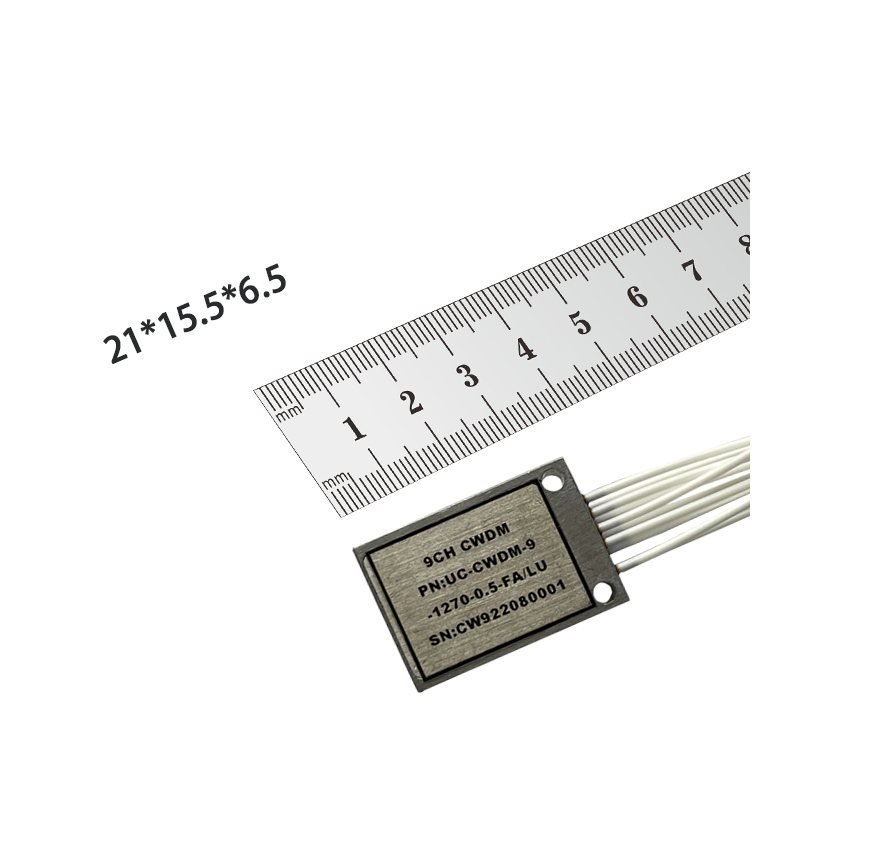
This is the same reflective-cascade platform carrying nine filter stages instead of four, built to a CWDM channel plan. The package grows from the 20×8×6.5 mm starting point mainly in one dimension — more stages need more length along the folded mirror path to fit them — while the thickness (6.5 mm here) stays close to the baseline. More channels is more stages sharing the same bench, not a different construction.
Specifying a UCWDM part
- Channel plan — CWDM, LWDM or DWDM assignment for each output, which sets the tolerance budget the build has to hit.
- Channel count — how many filter stages the folded path carries, which sets how far the package grows past the 20×8×6.5 mm baseline.
- Fiber length and connector — bare pigtail or terminated, per leg, same as the rest of the WDM range.
Get the channel plan right and the package follows from the channel count. Confuse a CWDM-plan part for a DWDM-plan part because they share a footprint, and the alignment tolerance you actually needed was off by a factor of sixty.