PM Circulator: Cylindrical vs Boxed, by the Test Data
A circulator is a non-reciprocal three-port device: light entering Port 1 exits Port 2, light entering Port 2 exits Port 3, and nothing takes the path backward. Two real builds on this page do exactly that job in two very different housings — and the housing turns out to track a real difference in spec floor, not just size.
Send light in Port 1 and it comes out Port 2. Send light in Port 2 and it comes out Port 3. Try to send it back into Port 2 from Port 3's direction and it doesn't return to Port 1 — that one-way routing is what makes a circulator useful for separating an outgoing signal from its own reflections, without the loss a splitter would cost.
Two real builds, two housings
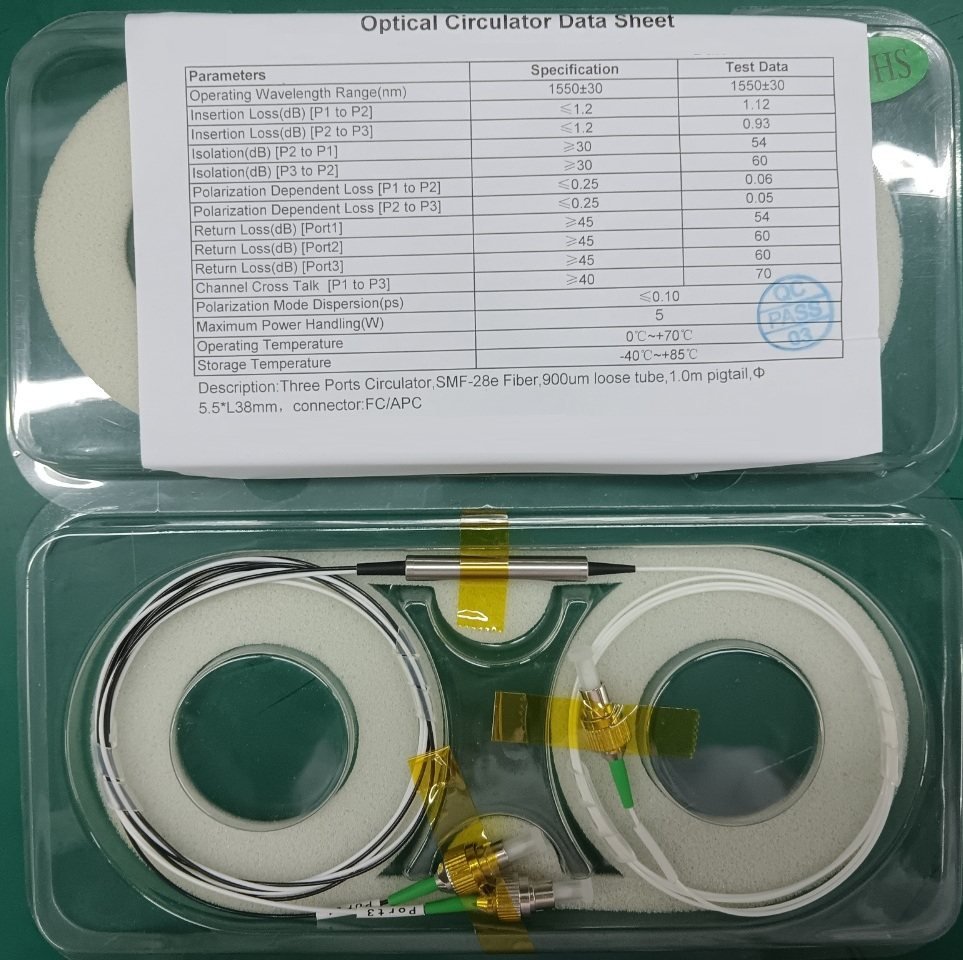
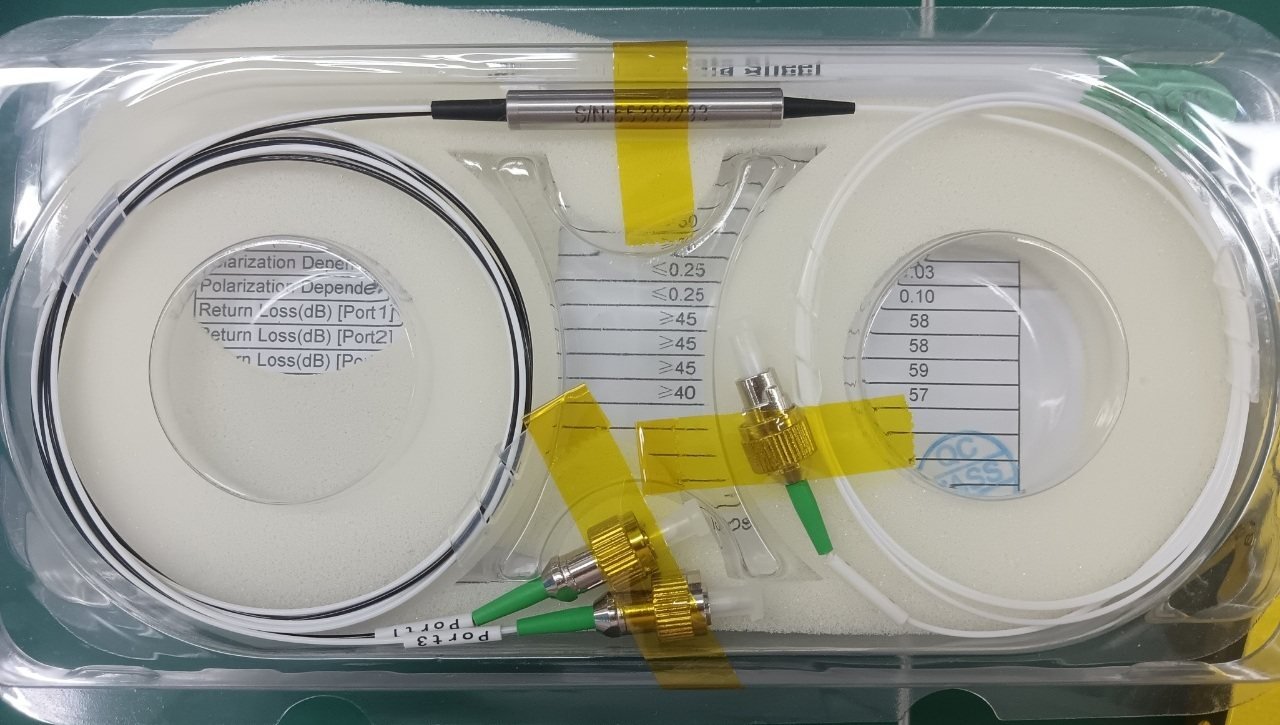
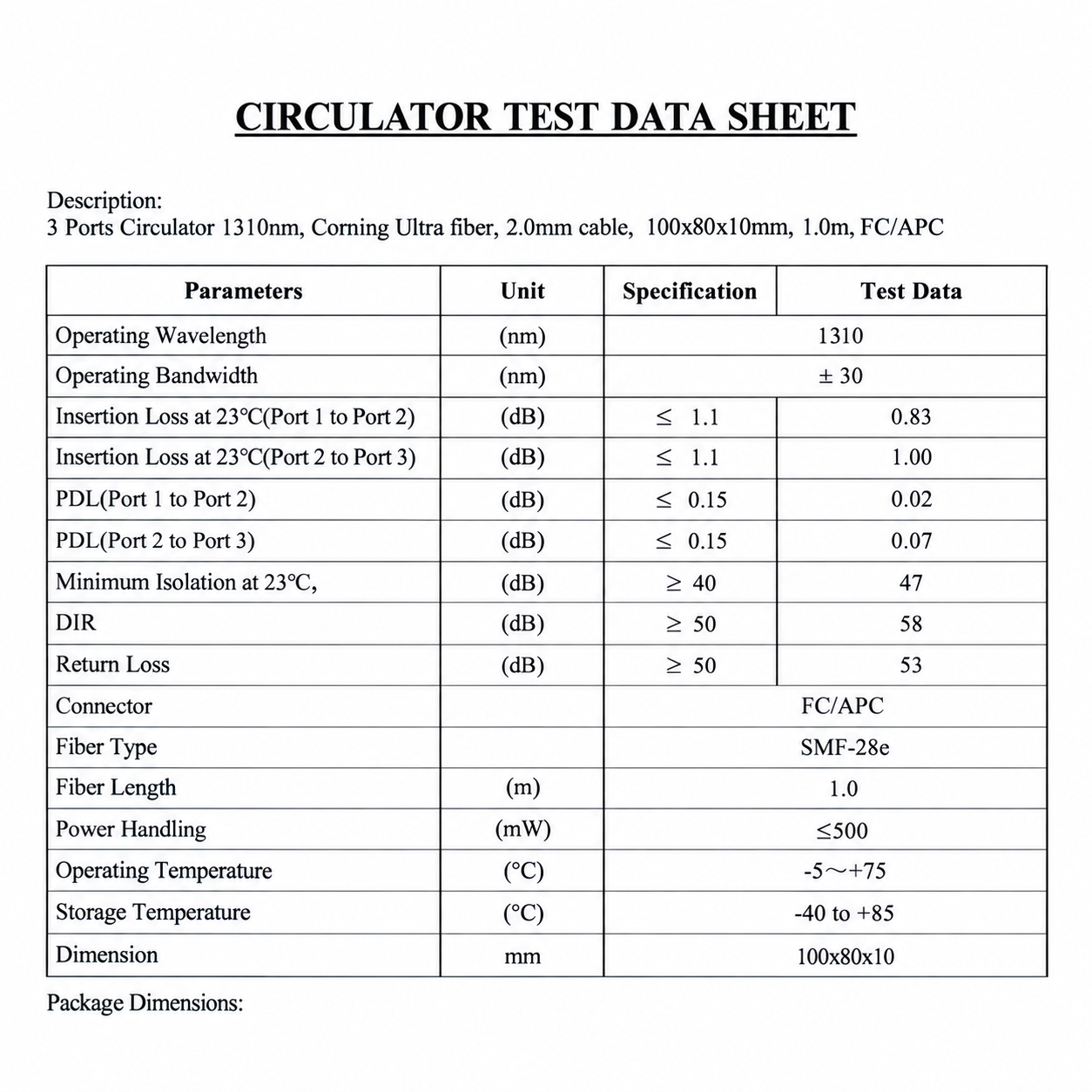
The photo above is a 3-port circulator built at 1550 nm: Φ5.5×L38 mm cylindrical package, SMF-28e fiber in 900 µm loose tube, 1.0 m pigtails, FC/APC connectors. The table below is the actual factory test data for that unit, next to a second real build at 1310 nm in a flat 100×80×10 mm box.
| Parameter | 1550 nm, cylindrical | 1310 nm, boxed |
|---|---|---|
| Package | Φ5.5×L38 mm | 100×80×10 mm |
| Fiber / cable | SMF-28e, 900 µm loose tube | Corning Ultra fiber, 2.0 mm cable |
| Insertion loss, P1→P2 | ≤ 1.2 dB (measured 1.12) | ≤ 1.1 dB (measured 0.83) |
| Insertion loss, P2→P3 | ≤ 1.2 dB (measured 0.93) | ≤ 1.1 dB (measured 1.00) |
| Polarization dependent loss | ≤ 0.25 dB (measured 0.05–0.06) | ≤ 0.15 dB (measured 0.02–0.07) |
| Isolation (minimum) | ≥ 30 dB (measured 54–60) | ≥ 40 dB (measured 47) |
| Return loss | ≥ 45 dB (measured 54–70) | ≥ 50 dB (measured 53–58) |
| Power handling | 5 W max | ≤ 500 mW |
| Operating temperature | 0 to +70°C | −5 to +75°C |
The boxed 1310 nm build carries a tighter spec floor across insertion loss, PDL and isolation than the cylindrical 1550 nm build — but it trades that for a much lower power handling ceiling, 500 mW against 5 W. Neither package is simply “the better one”: a fiber-laser feedback path that needs to survive watts of circulating power wants the cylindrical build's headroom; a low-power sensing or coherent-receiver path that needs the tightest possible PDL and isolation floor is better served by the boxed build.
Why polarization dependent loss gets its own line
Every circulator spec sheet on this page lists polarization dependent loss (PDL) as a headline parameter, not a footnote. A circulator with high PDL doesn't just cost extra dB — it costs a different amount of dB depending on the polarization state of the light passing through, which is exactly the kind of instability a coherent receiver or a polarization-multiplexed link can't tolerate. Holding PDL to 0.25 dB or tighter, as both builds here do, is what lets a circulator sit in a signal path that's already carrying polarization-encoded information without corrupting it.
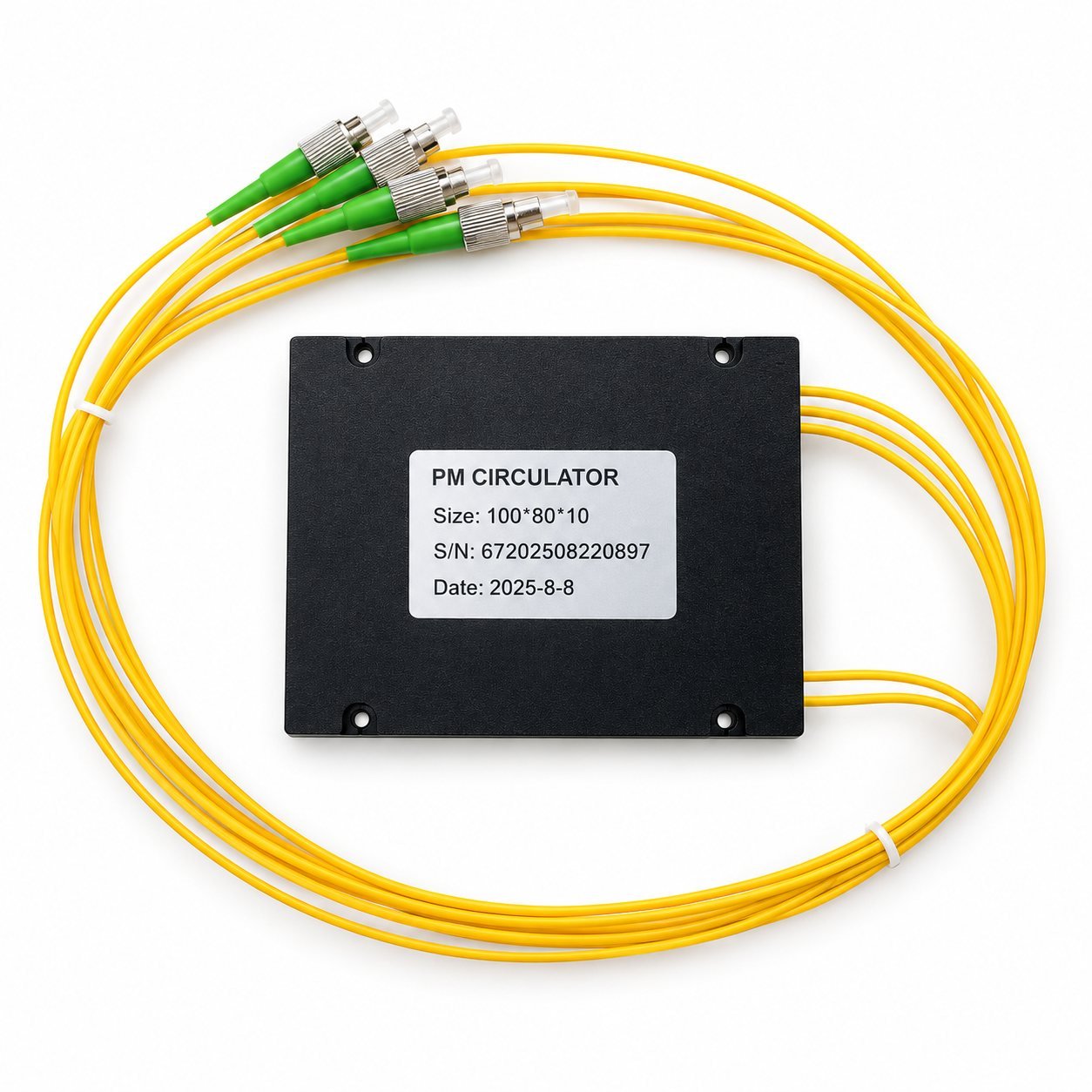
What the boxed package looks like assembled
Specifying a PM Circulator
- Wavelength band — sets the baseline insertion loss and isolation figures.
- Package — cylindrical or boxed, which as shown here also tracks a real spec-floor and power-handling tradeoff, not just footprint.
- Operating axis — single-axis where only one polarization state needs routing, dual-axis where both need to be preserved through the device.
- Fiber, connector and pigtail length — set per leg as with the rest of the PM line.
Return loss and isolation floors are configuration-specific rather than one fixed number across the whole PM Circulator range — ask for the datasheet at your exact wavelength, package and axis configuration before locking in a design.