FWDM Band Options: Choosing the Right Wavelength Pair
FWDM is the simplest WDM device we build — two bands, three ports, one small package — which makes the wavelength pair the only decision that really matters. It ships in six standard band options, from the everyday 1310/1550 nm bidirectional pair to full O+C+L band coverage, and picking the wrong one is not something packaging or connector choice can fix afterward.
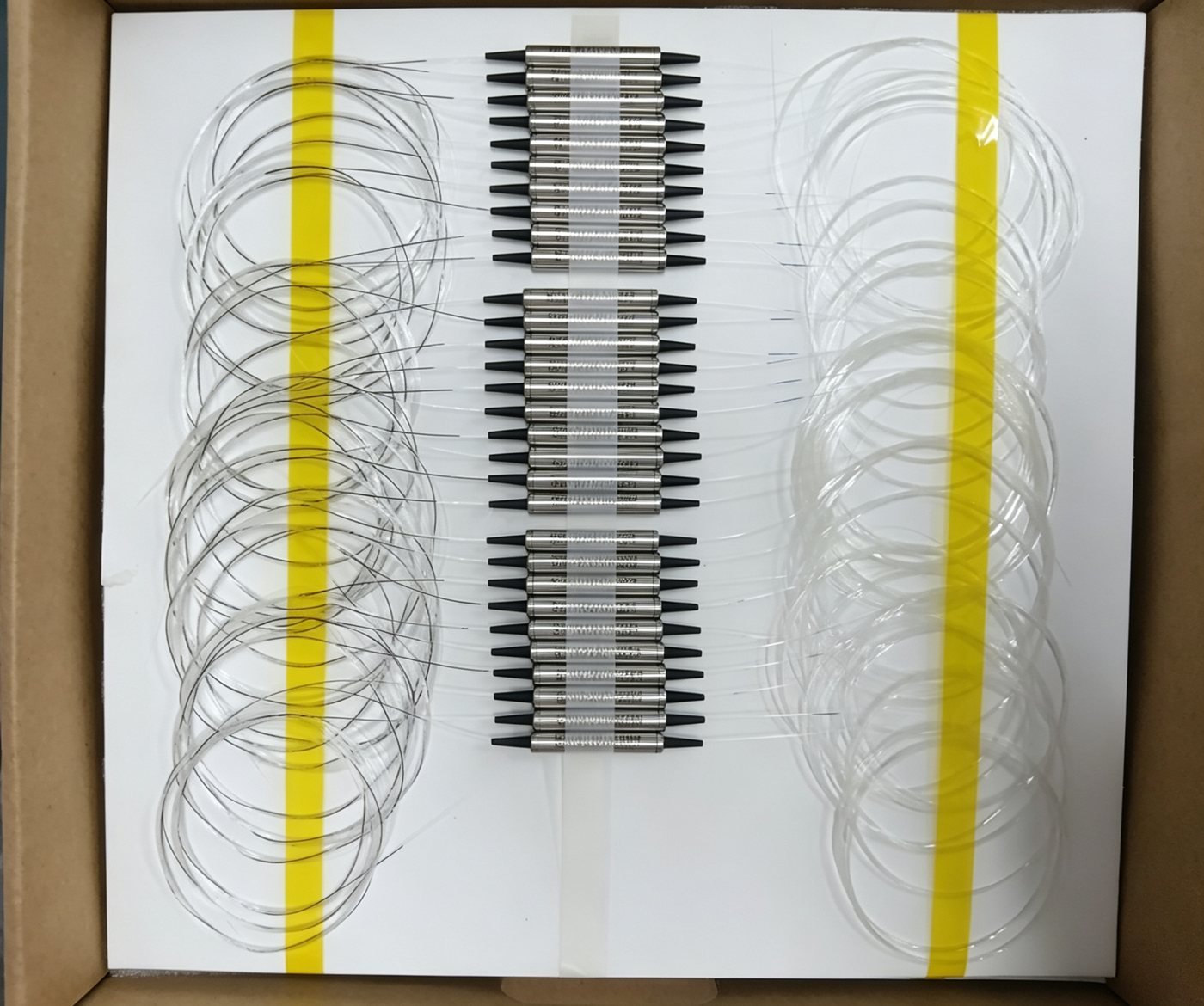
A filter WDM is the simplest possible wavelength splitter: two bands in on the reflect and pass ports, one fiber out on common — or the reverse, two signals combined onto one fiber. There is no channel plan to select, no grid spacing to think about, no add/drop configuration. The one decision that defines the part is which two bands it separates.
The baseline numbers
Whatever band pair you choose, the loss and isolation budget starts from the same specification:
| Parameter | Value |
|---|---|
| Insertion loss, pass path | ≤ 0.6 dB |
| Insertion loss, reflect path | ≤ 0.4 dB |
| Isolation, transmission (standard bands) | ≥ 30 dB |
| Isolation, transmission (1260–1620 nm wideband) | ≥ 40 dB |
| Isolation, reflection | ≥ 15 dB |
Two things are worth noticing here. First, loss is symmetric and low across every band option — there is no “harder” wavelength pair that costs you extra dB. Second, the reflect path is specified tighter on loss (0.4 dB) than the pass path (0.6 dB), which is typical thin-film filter behavior: transmission through the coating stack loses a little more than reflection off its surface.
The band options, and what each one is actually for
Six standard band options cover the range from a single common pair up to full-band monitoring coverage. The four most frequently ordered:
1310 / 1550 nm — the default bidirectional pair
This is the band combination behind most bidirectional single-fiber links: one wavelength carries the upstream signal, the other carries downstream, and the FWDM at each end separates them back onto their own receivers. If you are not sure which option you need, this is very likely it — it is the pair used across the largest share of FWDM orders we build.
1550 / 1650 nm — PON monitoring splits
1650 nm sits just above the PON data bands and is the standard wavelength for maintenance and monitoring traffic — typically OTDR test signals injected onto a live PON without disturbing the 1550 nm data path. An FWDM on this pair pulls the monitoring wavelength off (or onto) the line cleanly.
1260–1620 nm wideband — full O+C+L coverage
This is the option that steps outside a simple two-wavelength pair and covers the O, C and L telecom bands in one part, at the higher 40 dB isolation figure. It is specified where a system needs to separate a broad low-wavelength range from a broad high-wavelength range rather than two discrete lines — monitoring and test-access applications most often.
1600–1670 nm — L-band and monitoring
The highest standard wavelength range in the FWDM line, used where the application specifically needs to isolate deep L-band or monitoring wavelengths from the rest of the spectrum.
Bare pigtail or connectorized — set independently of the band
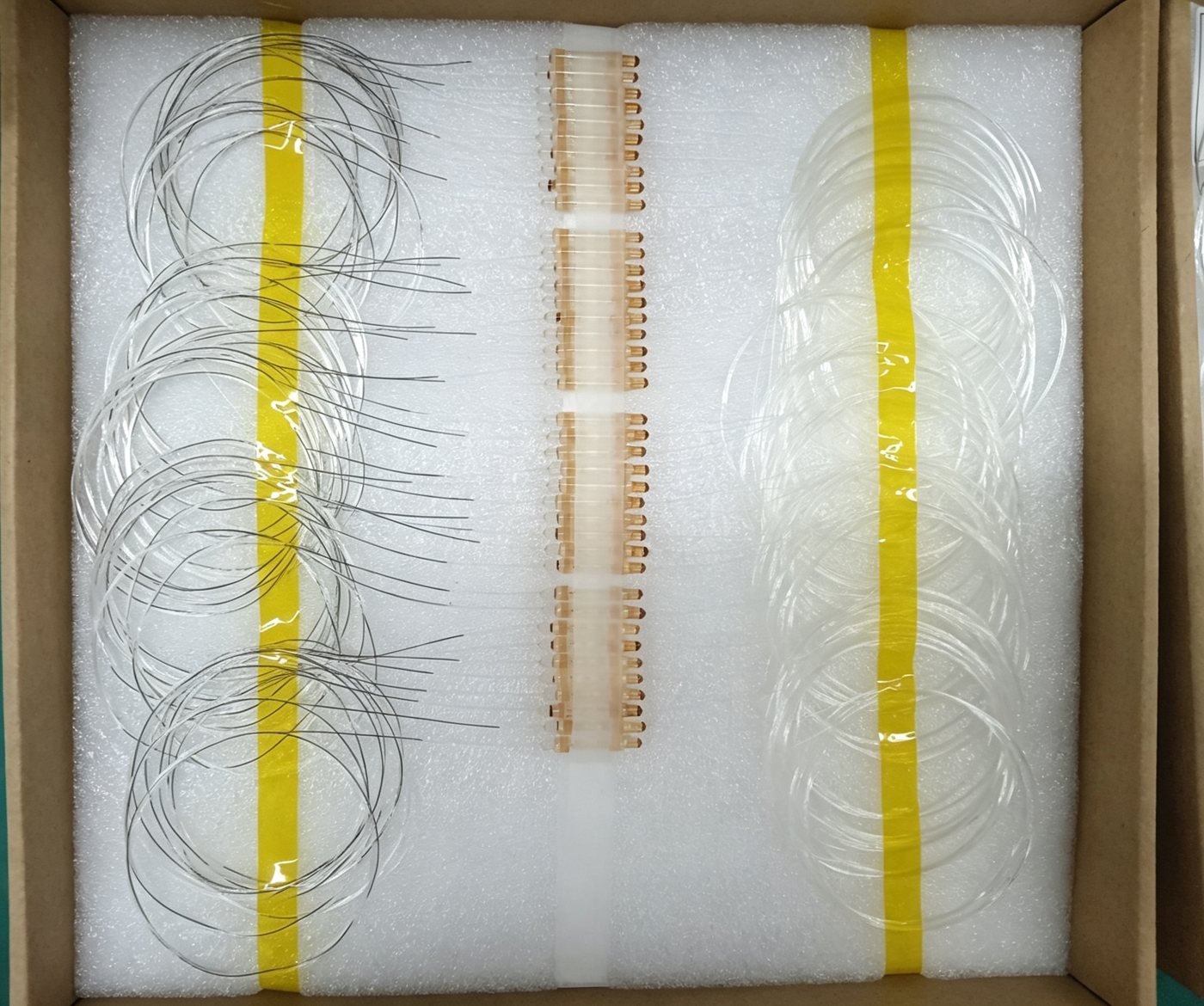
The wavelength pair and the termination are decided separately. Both photos in this article show the same 1×2 FWDM device family — one batch bare pigtail, ready for the customer’s own splicing or termination line, the other fully connectorized on all three legs. Neither affects the filter’s optical performance; both are just where in the assembly process you want to take delivery.
Specifying an FWDM
Four things determine the build:
- Wavelength pair — from the six standard band options, or a custom pair if your system needs one.
- Package size — set to fit your assembly, independent of the wavelength pair.
- Fiber length — per leg, to your drawing.
- Connector — bare fiber or terminated, per leg, independent of the other three.
Get the wavelength pair right and the rest of the specification is standard catalog work. It is also the one line on the RFQ you cannot change later without rebuilding the part.